Nicolas Bentley Drew the Authors

by Emilie Fournet on May 14, 2012

Nicolas Bentley, one of the most prominent English illustrators of the mid-20th century, always considered himself to be an author rather than simply a cartoonist. His oeuvre, which includes several books and several hundred more cartoons and illustrations, has one common thread – the telling of stories.

"You ought to be used to walking home by now." - The London bus strike continued for five weeks.

Bentley was never a caustic satirist, rather the clean lines of his stark black ink drawings drew attention to the stories recognisable in everyday life: the funny, the sad and the ridiculous. His celebrated contributions to Punch and later to Private Eye were prized for their accuracy, offsetting the more searing articles they accompanied, adding richness to the jokes with intricate narratives of their own.

"I don't think I'll bother to read it. I'll wait and see the film." - On 2 March 1960 the Guillebaud committee published its report on railway workers' pay, recommending substantial pay increases.

For this lover of stories and one who with a rich literary heritage (his godfather was G. K. Chesterton and his father invented the clerihew), it is little wonder he found such a rich source of material in the illustration of authors, often seeming to enjoy the game of adding satirical flavour to his literary drawings.

A noticeably supercilious Lord Byron.

In his various author illustrations, mostly produced throughout the 1960s to accompany book reviews in the Sunday Telegraph, Nicolas Bentley displays some of his most overt narrative sensibilities. Notably his drawing of Byron published in the Sunday Telegraph in 1966 adapts Byron’s features to match his iconic status – adding a quiff and unmistakably Elvis-esque curl of the lip.

John Keats: the poet's large eyes are touched in green.

A portrait of John Keats in 1965 for the same paper shows the poet with his hand under his chin, with enormous green eyes gazing into some romantic distance – the perfect image of a 60s daydreaming adolescent.

Albert Einstein, George Bernard Shaw, Josef Goebbels and Arturo Toscanini in a wooden crib.

He goes further into comic interpretation in other drawings, in which he has contrived a stand-alone narrative to complement the book review or article. From the unusual grouping of Einstein, George Bernard Shaw, Joseph Goebbels and Arturo Toscanini as babies in a wooden crib (Goebels slashing the air with a cosh) to the more traditional comic framing of a fully grown Gustave Flaubert fleeing an old woman – his mother with whom he lived for most of his adult life.

The French novelist Gustave Flaubert, hat in hand, flees from a wailing old widow, presumably his mother with whom he lived most of his adult life.

In all of these drawings, Bentley’s tendency towards the narrative of the everyday is irresistible. He takes great writers – many of whom he would have respected and admired – and gives them qualities instantly relatable to the more mundane lives of his audience.

Sherlock Holmes, with magnifying glass, and Dr Watson investigate the mysterious rise of the young David Frost, host of That Was The Week That Was.

Through his pin-ups, moody adolescents, screaming babies and long-suffering mummy’s boys, this collection of Nicolas Bentley’s work gives us a picture not just of historical and literary figures as we never expected to see them, but they tell a story about the time his pictures were published. Like all great storytellers, Bentley had the power to show readers themselves, as well as the men and women in the pictures he drew.

Works from Bentley’s literary portrait collection , and others, can be seen in our Nicolas Bentley catalogue.

"When you say he's an unsuccessful author, you mean he wasn't called to give evidence?" - Virtually every published novelist alive had been called to give evidence in the Lady Chatterley trial.


Railway Series Update

by Laura Massey on May 14, 2012

Last week we posted about some Railway Series pre-cut models from the 1950s that we wanted to know more about, and reader Justin A. Olsen kindly replied:

I saw your page on the Railway Series Press-Out Models, and wanted to throw in my own comments.

These models were first published around 1957 by the same group who published the main books at the time (Edmund and Ward). Card modelling was quite popular at the time however most of these models (Micromodels, Modelcraft, etc.) were at smaller scales and tended to be complex. It seems the Railway Series engines were made to be built up by those with less experience, but the models’ artwork does look nice (I’ve considered building “Gordon” from the scans you showed).

Other engines that were available were Thomas (with coach Annie) and James. The ads always suggested other models were in preparation, but nothing else ever appeared. I would presume they stopped publishing these around the 1960′s or 1970′s once Awdry stopped making new books.

These models are very scarce, I’ve only seen one other example (Thomas) ever appear. Thanks for the scans you posted, I always wanted a go at building one of these models.

Thanks Justin! We’re still interested in purchasing the two models we don’t have yet, Thomas and  James, so if you have some you’d like to sell then do contact us by email or phone.

A Thomas the Tank Engine Mystery – Railway Series Pre-Cut Model Books

by Laura Massey on May 8, 2012

The Railway Series Pre-Cut Model Engine Book No. 2 - Percy with Clarabel the Coach.

Update (14 May, 2012):  Reader Justin A. Olsen has kindly replied to our request for additional information on these models; you can read his comments here. We’re still interested in purchasing the two models we don’t have, Thomas and James, so please contact us if you have any you’re willing to part with.

Can you help? We recently acquired two lovely items from W. Awdry’s The Railway Series. These “Pre-Cut Model Engine Books” each contain a story and the parts and instructions for making two toys out of card. We have Number 2: Percy with Clarabel the Coach and Number 3: Gordon the Big Engine & His Tender (click to enlarge the images):

Percy Pre-Cut Model.

Percy Pre-Cut Model Instructions.

I believe these were produced in the late 1950s, as The Eight Famous Engines, the final story book listed on the back of each volume, was published in 1957. Four different titles in the pre-cut model series are described as being available (with more in production), and we would love to know more about these and possibly locate copies of the other two, Thomas the Tank Engine and James the Red Engine.

Please do get in touch if you know more about these sets and their sales records, and especially if you have copies to sell. You can leave a comment on this post or contact us by email or phone.

Below, a few more photos of the model books. If you have a good printer you could even construct them yourself!

Clarabel Pre-Cut Model.

Percy & Clarabel Story.

The Railway Series Pre-Cut Model Engine Book No.3 - Gordon the Big Engine & His Tender.

Gordon the Big Engine instructions.

Gordon the Big Engine pre-cut model.

Gordon the Big Engine's tender pre-cut model.


Libraries & Rare Book Dealers’ Catalogues

by Laura Massey on April 24, 2012

Over the weekend a group of librarians, academics, and book dealers had a great twitter conversation about rare book dealer descriptions and their use in library cataloguing.

It started with Mike Widener’s post at the Yale Law Library Blog about his love of dealer catalogues and his practice of including their content in library catalogue entries. Mike listed the rules he follows and wrote that “The description adds value to our catalog. It records a wealth of information about the book that would be impossible to include in the online catalog record”.

This caught the attention of Jeremy Dibbell, who included it in his weekly Links & Reviews post, as well as John Overholt, and Sarah Werner, who began a twitter conversation hoping to get more input from other librarians and book dealers (you can read the entire thread, with Sarah’s comments, on Storify). I noticed the conversation about half-way through, and was about to chime in when Sarah kindly asked me and fellow dealer Brooke Palmieri (who recently wrote on the subject of bookdealer’s catalogues) for our input.

My reaction was very positive. My colleagues and I put a huge amount of work into our cataloguing, including original research and very careful consideration of how we present books, manuscripts, and other objects. They aren’t just things to be sold, they carry historical and cultural meanings of which we’re the temporary caretakers. Our goal is to do these justice, and it’s nice to know that our institutional colleagues appreciate it when we do a good job, and that they find our work useful in the larger context of academic librarianship.

Additionally, as dealers we often use library catalogues to do research, and anything that could enhance the experience appeals to us. Dealer descriptions often include provenance and bibliographical information that might be difficult to include otherwise, and they can provide excellent search terms for those browsing a catalogue.  I also love the idea of searching library databases and being able to see what other dealers have said about a book over the course of time. In the absence of a comprehensive database of dealer catalogues (which will probably not happen in the near future!) this is the best idea I’ve heard for making available this type of information.

One of the main points at issue during the discussion was that of credit. We all agreed that it’s essential to credit the dealer in the same way that you would cite a source in an academic article. Mike Widener also directly asks the dealer for permission before posting, and while this is definitely the polite (and legal!) way to proceed, my colleagues and I agree that it’s less important than giving credit (as long as there is no unique content in the cited catalogue entry, which it was pointed out, would require more careful consultation with the dealer).

Much of the discussion also hinged around the capability of various library systems to accommodate this type of information, and the procedures for cataloguing at different institutions. I hope that despite the differences between systems and philosophies, more institutions will follow Widener’s lead and find ways to incorporate dealer descriptions in their online catalogues.  As well as being practical, it’s a wonderful way to foster closer ties between institutions and dealers.  If any readers are librarians or rare book dealers with an opinion to contribute, please do chime in, either her, at the Storify feed, or or at the blogs of the various contributors.

The Birth, Death, and Rebirth of an English Genius: Shakespeare’s First & Second Folios

by Laura Massey on April 23, 2012

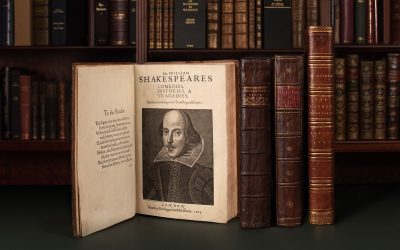
Our copy of the second folio edition of the plays of William Shakespeare (1632).


Tradition holds that William Shakespeare was born this day, 23 April, in 1564, though it’s impossible to know the date for sure. What is known is that he was baptised at Holy Trinity, the parish church of Stratford-on-Avon, on the 26th of the month, so was probably born sometime between the 21st and 23rd. The 23rd of April is also recorded as Shakespeare’s date of death in 1616, and it is this untimely event which we have to thank for the preservation and promotion of his works in the First Folio, and ultimately his enshrinement as one of England’s great geniuses.

Shakespeare was only 52 when he, Ben Johnson, and the poet-playwright Michael Drayton “had a merry meeting, and itt seems drank too hard, for Shakespear died of a feavour there contracted” (ODNB). As a memorial, his friends and fellow members of The King’s Men, John Heminges and Henry Condell, decided to produce a collected edition of his plays.

Eighteen of Shakespeare’s plays had been published during his lifetime, individually in cheap and probably unauthorised quarto editions, some of which became bestsellers. These often error-riddled editions are described in the First Folio as “stol’n and surreptitious copies”, and some seem to have been reproduced solely from the memories of actors trying to make a little cash on the side. This continued after his death, and in 1619 the publisher Thomas Pavier and printer Henry Jaggard produced ten quarto plays ostensibly by Shakespeare (though two were not actually his work), and this may have spurred Heminges and Condell to complete their own collected edition and reassert the King’s Men’s authority over the texts.

It wouldn’t be an easy process. Though the King’s Men held the copyrights to many of the plays, it took years to negotiate for others, which remained with the publishers of the quarto editions. Though these publishers did not have what we today would consider intellectual priority over the works, they had been the first to enter them in the Stationer’s Register, which gave them the copyrights. Some even had to be brought in as partners, earning shares of the proceeds of the First Folio based on how many plays they contributed. Henry Jaggard himself served as the head printer on the project until his death in 1623.

The printing began in early 1622 and took around two years to complete, with the earliest known sale of a First Folio occurring in December 1623. The choice of the imposing folio format was vital to the book’s success, “giving the volume the instant status of a classic:  it is a weighty tome, a book for individuals’ libraries, a collection perhaps to be owned rather than read… It was also expensive, probably not less than 15s. a copy and often costing £1 or more” (ODNB). Prior to this, theatre in England had been considered low-brow, and no collection of plays had been published in such a lavish manner. The First Folio elevated not only Shakespeare’s reputation, but that of play-writing in general.

Most importantly, the First Folio included 36 of Shakespeare’s 38 known plays, 18 of which had never before been printed and would probably have been lost to history if not included. And the texts, edited by Shakespeare’s close friends and his fellow writers and actors, are considered the most authoritative of all early printings. Shakespeare’s reputation today rests largely on the publication of the First Folio.

Despite its expense, the book sold well enough that a second edition, the Second Folio, was required in 1632. Published by a syndicate of five firms, copies appear with one of five different imprints depending on which publisher sold them. Our copy, pictured above, has the scarcest imprint, that of the publisher John Smethwick, who owned the rights to four plays: Hamlet, Romeo & Juliet, Love’s Labour’s Lost, and The Taming of the Shrew. Despite the importance of these titles, Smethwick’s small contribution of four plays meant that his share of finished copies was relatively low, and his imprint correspondingly scarce. Also of note–the second Folio contains the first appearance in print of John Milton, who contributed a poem to the Effigies leaf that did not appear in the first edition.

Two more folio editions of Shakespeare’s plays were published by the beginning of the eighteenth century, followed by a number of important editions edited by authors such as Samuel Johnson and Alexander Pope. Today, though, the most highly sough-after editions are still the early folios, with the First Folio becoming one of the most valuable books in the world. Around 750 copies were printed, but only 230 survive, and of those only 40 are complete. Most extant copies are held in libraries, and in the last decade only three have been sold at auction, all achieving prices in the millions of dollars. As much as we hate to have second-best books here at Peter Harrington, the Second Folio is a second-best we’re glad to have, as it is the earliest edition of Shakespeare that is practicably obtainable on the market.

If you’re interested in purchasing this copy of the Second Folio please contact us at +44 (0)20 7591 0220, or by email. Click here to see other rare and finely bound books by Shakespeare.

For more information about Shakespeare’s publishing history try these links:

The binding on our copy of the Second Folio of Shakespeare.


The First Book on the Loch Ness Monster

by Laura Massey on April 10, 2012

First edition of The Loch Ness Monster and Others by Rupert T. Gould (1934).

Today we often laugh about the myths that have grown up around the Loch Ness Monster. Recalling all the hoaxes, we wonder how people could be so gullible. But when the first widely-reported sightings stoked a media frenzy in 1933 it was unclear what was happening and many people, journalists and scientists alike, believed it possible that some type of unusual animal could be living in the loch. This led to the first ever book on the monster, The Loch Ness Monster and Others, a 1934 collection of eyewitness accounts gathered by Rupert T. Gould (1890–1948), a renowned horologist and former Lieutenant Commander in the British Navy.

Rupert T. Gould, horologist and author of The Loch Ness Monster and Others.

The first major Loch Ness sighting was reported by a London man named George Spicer who claimed that on 22 July, 1933, while driving with his wife along the east side of Loch Ness, something like a “pre-historic animal” crossed the road ahead of them “carrying a lamb or small animal of some kind” in its mouth. Spicer’s detailed account was reported in the Inverness Courier a few weeks later and more sightings (many of which were anonymous) began pouring in. The first photograph purporting to be of the creature was taken by Hugh Gray in November of the same year. It was published in the Daily Record and Mail and reproduced as Plate I in Gould’s book:

The first photograph ever taken of the Loch Ness Monster.

The most famous photograph was taken the following spring, when a London gynaecologist named Robert Kenneth Wilson snapped what became known as “The Surgeon’s Photograph”. Though later revealed as a hoax, this image fueled the mania surrounding the sightings, and is used on the dust jacket and as the frontispiece to Gould’s book.

The Surgeon's Photograph of the Loch Ness Monster (1934).

Spurred on by these media accounts, Gould took it upon himself to investigate the mystery. He was already a well-known horologist: in 1923 he published The Marine Chronometer, “a book so thoroughly researched and well written that it still had no equal seventy-five years later” (ODNB), and in his free time he restored the Royal Observatory’s Harrison timekeepers, which had solved the problem of how to determine longitude at sea. (Gould was was played by Jeremy Irons in the 1999 television adaptation of Dava Sobel’s Longitude.) He amassed a large collection of typewriters, and extensive notes for a possible history of the machines. But he was also interested in mysteries and monsters, having written three books on similar subjects: Oddities (1928), Enigmas (1929) and The Case for the Sea Serpent (1930).

One of the first to systematically investigate the Loch Ness Monster, Gould set off from Inverness on a motorcycle on 14 November, 1938 and circled the Loch twice over a period of days. He interviewed as many witnesses as possible, including the Spicers, and investigated various theories for the sightings, such as the idea that the monster was a prehistoric creature, or perhaps a normal sea animal that had swum into the loch by accident.

The book which resulted from his travels is highly detailed and includes reports on all known sightings, including some that occurred prior to 1933. It’s also copiously illustrated; all three of the photographs then believed to be of the monster are included, in addition to numerous sketches based on eyewitness accounts:

The Loch Ness Monster as described by the Spicers.

Unfortunately, many of the sketches are more humorous than illuminating:

Others are tragically unconvincing:

One of the best things about our particular copy of the book is that a previous owner left annotations. There’s a section of photographs of unidentified animals that have washed ashore on beaches around the world–Gould argued that these might be specimens of the same creature that was living in the loch. Below each image our anonymous, and skeptical, reader has scrawled “almost certainly basking shark” (though some appear to me as giant squid or other types of animals):

But their best contribution is this charming illustration in the conclusion:

As you can probably tell from the text in the photo above, Gould’s conclusion was that there was a creature living in Loch Ness. Though he was almost certainly incorrect, he should be remembered as one of the earliest and most thorough of Loch Ness investigators, whom we have to thank for the preservation of much information relating to the creature and the people who saw her.

I’m sorry to say that we don’t have a “Mysteries” section on our website, so I’ve put Nessie into the “Sciences” category, which you can browse here.